Taiwan to Face Three Challenges in 2028
China Times Editorial, September 9, 2026
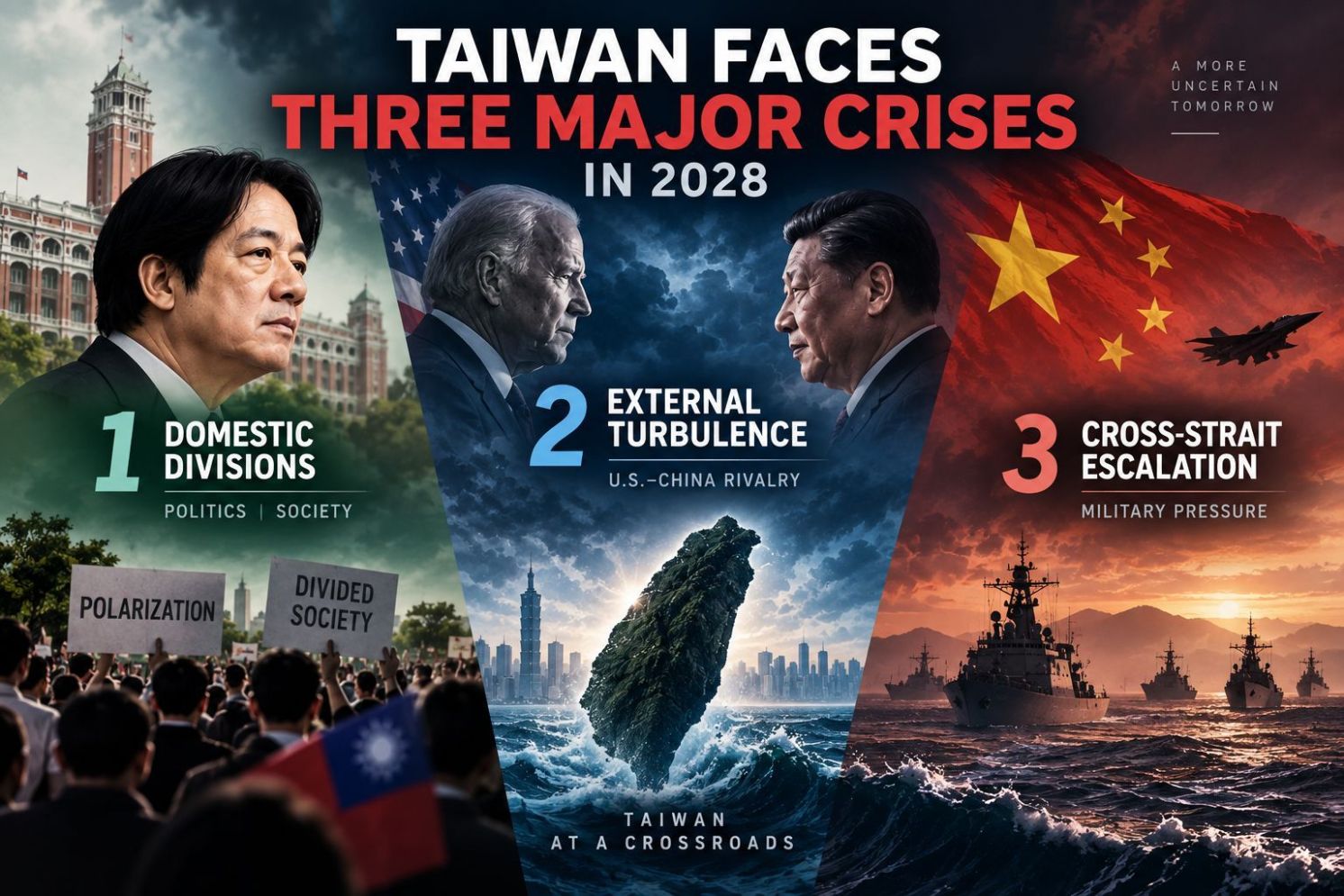
In 2028, Taiwan will face a threefold crisis of “internal divisions, external turbulence, and the approaching showdown across the Taiwan Strait.” The threefold crisis stems from three interconnected and mutually confrontational political processes involving President Lai Ching-te, Chinese President Xi Jinping, and the people of Taiwan. Variables in U.S.-China relations may make these three crises even more dangerous, and the people of Taiwan need to awaken and save themselves.
President Lai’s political process centers on consolidating his administration, advancing national security and defense policies, and seeking re-election in 2028. The United States is deeply involved in this process. From defense, technology, and supply chains to U.S.-China competition, all will influence the Lai administration’s policy choices. Taiwan has been incorporated into the U.S. Indo-Pacific strategy and technology security system, and the degree of autonomy available to the Lai administration in security policy will, to some extent, be influenced by the competitive and cooperative dynamics between the United States and China.
Mr. Xi also has his own political process. Beijing cannot wait indefinitely for Taiwan to agree to unification. In the future, it will inevitably step up its use of various means—including military, diplomatic, legal, economic, and social measures—to narrow the space for Taiwan independence, increase its influence over Taiwan, and build conditions for unification. Such pressure may not necessarily point directly toward war, but it could gradually alter the balance of power and political environment across the Taiwan Strait, making Taiwan feel that its room for choice is being squeezed diplomatically, in terms of security, economically, and psychologically.
The third process is the evolution of Taiwan’s domestic politics and social identity. As the separation between the two sides continues over time, the trend of distancing Taiwan from China will gradually become entrenched. This will not only reshape Taiwan’s domestic politics but also deepen Beijing’s assessment that the “conditions for peaceful unification are being lost.” In particular, as cross-Strait exchanges decline and social connections weaken, mutual understanding increasingly depends on political propaganda and security perceptions, making it easier for cross-Strait relations to shift from political differences to identity confrontation.
These three processes influence one another. The Lai administration emphasizes security and Taiwan’s autonomy, prompting Beijing to intensify pressure against Taiwan independence and in favor of unification. The greater the pressure from Beijing, the more Taiwan strengthens its anti-China and security narratives. The more distant Taiwanese society becomes from the mainland, the more Beijing worries that the state of separation is becoming irreversible. This is a typical security dilemma: each side believes it is responding to the other, but the cumulative result is that everyone’s sense of security declines.
Even if neither Taipei nor Beijing intends to initiate a war, the Taiwan Strait may still become increasingly dangerous. Wars often arise from accumulated mutual misunderstanding and suspicion resulting from prolonged tensions. As a result, at critical moments, the situation could fall into a prisoner’s dilemma of “strategic miscalculation” and “having no choice but to fight.”
Year 2028 is a critical juncture. If President Lai is re-elected and the Democratic Progressive Party (DPP) once again secures a majority in the Legislative Yuan, Beijing may interpret this as a renewed mandate for President Lai’s political path, with Taiwan’s internal political structure becoming entrenched in a direction of long-term separation.
For Taipei, this represents democratic authorization; for Beijing, it represents the continued loss of the conditions for peaceful unification. The same political outcome is interpreted in completely opposite strategic terms by the two sides. This is where the real danger in the Taiwan Strait lies.
More importantly, Taiwan can easily equate democratic procedures with policy legitimacy. Democracy is certainly Taiwan’s most important political foundation, but an electoral victory cannot resolve all national security issues. Even with majority support, the government must still confront the realities and constraints of geopolitics, military power, and the international environment. Democratic authorization can determine who forms the government, but it cannot change Taiwan’s fundamental position at the intersection of U.S.-China competition and cross-Strait conflict.
Voters must awaken: regardless of whether the Kuomintang (KMT) or the DPP is in power, or whether Taiwan adopts a pro-U.S., pro-China, or anti-China approach, what matters is how to establish a risk awareness that transcends political parties. Several basic realities must be understood: votes do not constitute unlimited authorization; strengthening national defense cannot replace exchanges, communication, and dialogue; Beijing’s intentions and capabilities cannot be ignored; and Taiwan’s security cannot be outsourced to the United States. The United States can be an important security partner for Taiwan, but U.S. and Taiwan’s interests cannot possibly be completely aligned. Taiwan must have the ability to determine which forms of cooperation can enhance security and which arrangements may instead increase the risk of being drawn into great-power competition.
From: https://www.chinatimes.com/opinion/20260909003844-262101?chdtv